

How to improve brand visibility in AI search engines
Protect the metric before trying to improve it: exclude direct-brand prompts from overall Mention Rate, keep genuine comparison prompts included, and retain every answer for prompt-level sentiment analysis. Then measure a fixed set of buyer questions, find where your brand is absent or unsupported, and repair the source closest to that gap. AI visibility separates a brand mention, a domain citation, and a recommendation because they are different outcomes.
Brands improve their visibility in AI answers by giving engines a clear, accessible, and useful source for a buyer question. The measurement only works when the prompt set does not manufacture its own mentions. Publishing more pages without that diagnosis usually just creates more pages for an engine to ignore.
What does brand visibility in AI search actually mean?
AI search visibility is the degree to which an answer engine represents your brand when a buyer asks a relevant question. That representation has three useful layers.
- Mention: the answer names your brand.
- Citation: the answer links to or names your domain as supporting evidence.
- Recommendation: the answer presents your brand as a fit for the question's stated needs.
The layers can move independently. An engine may mention a familiar brand from its general knowledge yet cite a competitor's pricing page, documentation, or comparison because that source gives it a tighter answer. Treating all three as one score hides the work that is actually missing.
Which prompts should count toward the visibility baseline?
Start by separating prompts that test whether a brand can be discovered from prompts that practically supply the brand name. If a prompt names your brand and asks only about it—“What does PilotCite do?”—a mention is structurally likely. Counting that result in Mention Rate can make the metric look healthier without proving that the engine discovered your brand.
Comparison prompts are different. “PilotCite vs [competitor] for weekly citation reporting” names the brand because the buyer's decision requires it. Keep comparison prompts in the overall visibility metric set. Also retain the answers from every prompt type for prompt-level sentiment analysis, even when a direct-brand prompt is excluded from overall Mention Rate and Citation Rate.
Use this classification before treating the prompt set as a baseline:
- Category or discovery prompt. Include it in headline visibility metrics because the engine must choose whether to surface your brand.
- Direct-brand prompt. Exclude it from headline mention and citation rates, but keep its answer for prompt-level sentiment and accuracy review.
- Brand-comparison prompt. Include it because naming both options is part of a real evaluation, not a shortcut to discovery.
- Bare-competitor prompt. Exclude it from your brand's headline visibility metrics, while retaining the answer for competitor and prompt-level sentiment analysis.
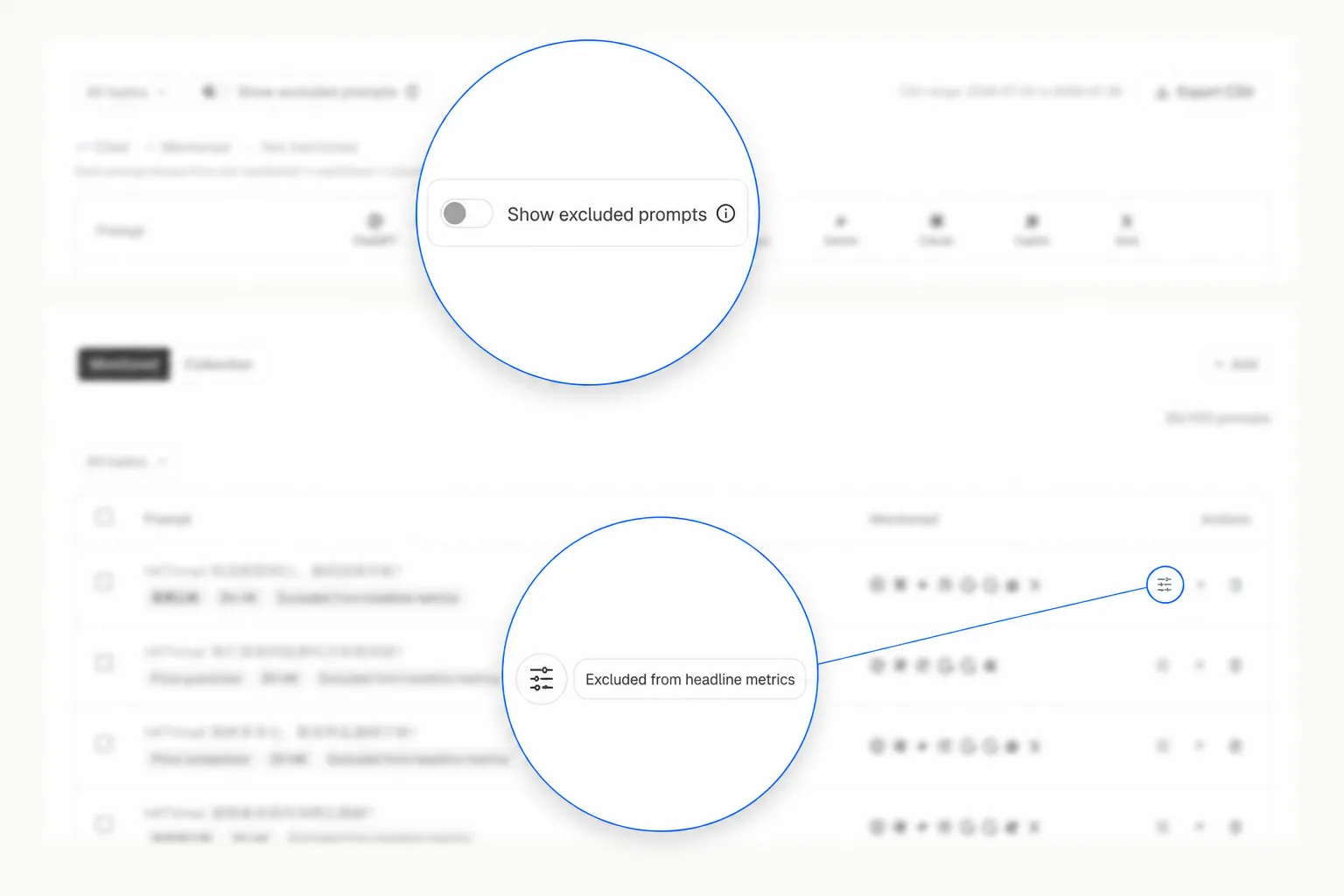
PilotCite citation monitoring assigns a metric scope automatically, lets you show or hide excluded prompts in Monitoring, and lets you override each prompt with Automatic, Include, or Exclude in Prompts. Review the automatic choice when local wording expresses a real comparison that a classifier may miss.
Do not turn the baseline into a keyword dump. Ten distinct buyer decisions are more informative than fifty near-duplicates, because each answer points to a different proof obligation: category definition, product fit, pricing, implementation, or trust.
What makes a page a credible source for an AI answer?
An engine cannot cite a page it cannot retrieve, cannot connect to a stable entity, or cannot use to support a specific claim. Those are separate checks, and fixing the first failed one is the shortest path forward.
First, make the relevant page accessible in server-rendered HTML and avoid blocking the crawler that needs to read it. Next, make sure the brand facts on that page agree with the rest of your site and public profiles; entity consistency gives the engine a reliable subject to attach the claim to. Finally, give the page a self-contained answer unit: a question-matched heading, a direct first sentence, and a concrete detail the engine can carry into its response.
How do you turn an answer gap into a page worth publishing?
Read the answer that lost you the slot before drafting anything. If the engine cites a competitor's implementation guide, a broad thought-leadership article is the wrong reply. If it names you but cites no page you control, the gap may be entity clarity or a missing source page rather than ranking.
Suppose a monitored answer recommends two tools for weekly citation reporting and cites their feature pages. Open those cited pages and write down the exact buyer requirement they satisfy: reporting cadence, supported engines, export format, or a stated limit. Your response should be a page that answers the same requirement honestly, with your own product facts, instead of a thin imitation of their headline.
That is why writing content AI engines can cite is less about sounding authoritative than making a claim easy to verify in context. A short section that answers one question cleanly can be more useful than a long page that never commits to an answer.
What does a four-week visibility loop look like?
The loop is deliberately small. It makes the signal legible before you scale the content calendar.
Week 1 — establish evidence. Run the baseline across the engines your buyers use. Save the full answer, cited domains, and the classification for each result.
Week 2 — fix the earliest failure. Choose one high-intent question and repair its source readiness: crawlability, factual consistency, or the answer unit on the page.
Week 3 — publish the missing proof. Create or expand the page only when the answer shows a real information gap. Link it from the most relevant existing page so both people and crawlers can find it.
Week 4 — compare, then decide. Rerun the unchanged prompt set. Keep changes that improve representation, and investigate the underlying answers before declaring a win or a loss.
Which signals tell you what to do next?
Use the combination of outcomes to choose the next action. More mentions with flat citations can mean the brand is recognized but its pages are not yet preferred as evidence. Citations without recommendations can mean the engine trusts a fact page but does not see enough proof of fit. No mention at all often points upstream: inaccessible content, unclear category language, weak corroboration, or a prompt your product genuinely should not win.
The useful question is never “Did our visibility go up?” It is “What changed in the answer, and what source earned that change?” That question keeps content, product facts, and distribution tied to observable work instead of vanity reporting.
- A mention names a brand; a citation identifies a source that supports an answer. One does not guarantee the other.
- A direct-brand prompt can inflate headline Mention Rate because the question already supplies the brand name; keep its answer for prompt-level sentiment instead.
- A brand-comparison prompt should remain included because naming both options is part of the buyer decision, not a discovery shortcut.
- A valid before-and-after comparison keeps the buyer prompt, engine, locale, and scoring rule stable.
- A page can only compete for a source slot after an engine can retrieve it and connect its claims to the correct brand.
Frequently asked questions
Live-retrieval engines can reflect a clearer or newly crawlable page after they revisit it, while broader brand recognition can take longer. Use repeated checks of the same prompt set rather than a promised timeline.
Track both. A mention shows that the engine recognizes the brand, while a citation shows that it selected one of your pages as evidence. The gap between them tells you whether to focus on source pages or brand clarity.
No. Expand an existing page when it can honestly answer the question. Create a new page only when the prompt exposes a distinct buyer decision or proof requirement that has no credible home yet.
Exclude direct-brand prompts from headline Mention Rate because the question makes a mention unusually likely. Keep genuine brand-comparison prompts included, and retain every answer for prompt-level sentiment analysis. Use a manual override when the automatic scope does not match the prompt intent.
Choose five to ten buyer prompts, run them on the one or two engines your buyers use most, save the answers and cited sources, then repair one repeated gap before measuring again.