

How to write content that AI engines actually cite
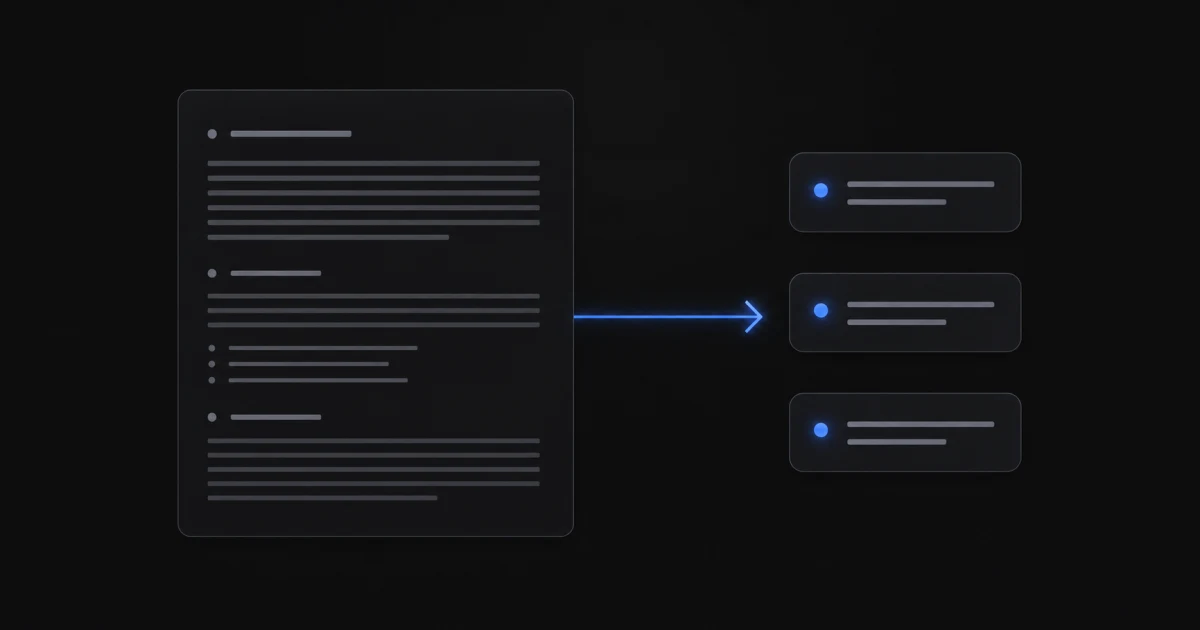
AI engines do not cite pages — they cite passages. A ChatGPT or Perplexity answer lifts a self-contained chunk of text that directly answers the question, then names the source. If your content buries the answer in narrative, leans on adjectives instead of specifics, or cannot be read without its surrounding context, it gets summarized without attribution. This guide turns the mechanics of how engines choose what to cite into concrete writing rules you can apply to every page.
Most content written for search was optimized for a reader scrolling a results page: hook the click, hold attention, build to the payoff. AI engines invert that. They do not scroll, they do not get hooked, and they have no patience for narrative build-up. They extract the passage that answers the question — and if that passage is not cleanly extractable from your page, your competitor's is.
The shift is not about writing worse or dumbing things down. It is about understanding what an AI engine's extraction layer does to your text, and structuring content so that what it lifts is yours, attributed, and correct.
Why engines cite passages, not pages
When someone asks an AI assistant a question, the engine runs a three-stage process: it retrieves a set of candidate pages, extracts the passages from those pages that appear to answer the question, then attributes the answer to the source it trusts most. You can win retrieval with good technical SEO and lose the citation in extraction — and that is where most content fails.
Extraction is mechanical. The engine is looking for a block of text that (a) directly addresses the question, (b) is self-contained enough to make sense outside the page it came from, and (c) contains specific, verifiable claims rather than vague descriptors. If your page has that block, it is citable. If it does not, the engine paraphrases your content — and a paraphrase usually arrives without your name attached.
The Princeton research that introduced GEO measured this directly: adding expert quotes, statistics, and citations to passages improved visibility by 41% on position-adjusted word count and 28% on subjective impression compared to unoptimized text (Aggarwal et al., 2023). The content was the same topic, the same length. What changed was structure and specificity — making the passage liftable.
The citable atom: the unit of content AI engines use
The fundamental unit of citable content is not an article, a section, or a paragraph. It is what we call the citable atom: a self-contained passage that answers one question, stands on its own without context, and contains a specific claim an engine can quote verbatim.
A citable atom has three properties:
- It answers a question directly. The question does not have to be stated, but the passage must clearly respond to one. "X costs $49/month for 5 seats" answers "what does X cost?" A paragraph about pricing philosophy does not.
- It is self-contained. You can lift it out of the page and it still makes sense. No "as mentioned above," no "in the previous section," no pronouns that only resolve with surrounding context.
- It is specific. It contains a number, a name, a date, a comparison, or a definition — something concrete an engine can attribute. "Monitors 8 AI platforms" is citable. "Comprehensive monitoring" is not.
The mistake most content makes is writing in narrative flow — building an argument across paragraphs — when engines extract atom by atom. Your article can still have narrative flow, but it must be built from citable atoms, not a substitute for them.
The seven rules of citable content
These are not theory. Each one maps to a specific stage of how AI engines process your page, and each one is testable: write a page both ways, run the same prompt against it, and watch the citation rate move.
1. Answer first, elaborate second
The single highest-impact change you can make. For every question your page targets, put the direct answer in the first two sentences of the section — before the explanation, before the context, before the nuance.
Weak: "Pricing is an important consideration for any team evaluating AI visibility tools. Many factors influence the final cost, including the number of brands monitored, the platforms covered, and the monitoring frequency. PilotCite offers a range of plans designed to scale with your needs."
Citable: "PilotCite costs $0 for 5 monitored ChatGPT prompts (Free plan) and scales to $49/month for multi-platform monitoring across 8 AI engines. Seat and brand limits increase at higher tiers."
The first version makes a human reader work to find the number. The second gives an engine a passage it can quote verbatim in one extraction step. Both can coexist — answer first, then elaborate — but the atom must come before the narrative.
2. One idea per section
Engines extract section by section. If a single H2 tries to cover pricing, features, and a comparison, the engine does not know which passage to lift for which question, and often lifts none of them cleanly. One H2, one question, one answer. This is not dumbing down — it is making your content parseable by a system that does not read the way a human does.
3. Specifics beat adjectives, every time
This is the rule the Princeton data validates hardest. Engines quote precision and paraphrase vagueness — usually without attribution. Compare:
- Not citable: "A powerful, comprehensive solution for modern teams."
- Citable: "Monitors 8 AI platforms (ChatGPT, Perplexity, Gemini, Claude, Copilot, Grok, Google AI Overviews, Perplexity Pages) with citation tracking on scheduled runs."
Every adjective you are tempted to write is a signal that you have not yet found the specific claim. Replace "affordable" with the price. Replace "fast" with the timing. Replace "comprehensive" with the list.
4. Fact density: a specific claim every 150-200 words
Analysis of high-performing GEO content shows that AI engines favor pages with high fact density — verifiable claims, statistics, names, and dates spaced regularly throughout, not clustered in one section. A long article with three facts buried in the conclusion gets extracted less than a shorter one where facts are distributed across every section.
This does not mean padding with random statistics. It means that every section should contain at least one concrete, quotable claim: a number, a name, a date, a definition, a comparison. If a section has no specific claim, ask whether it needs to exist.
5. Tables for comparisons, lists for steps
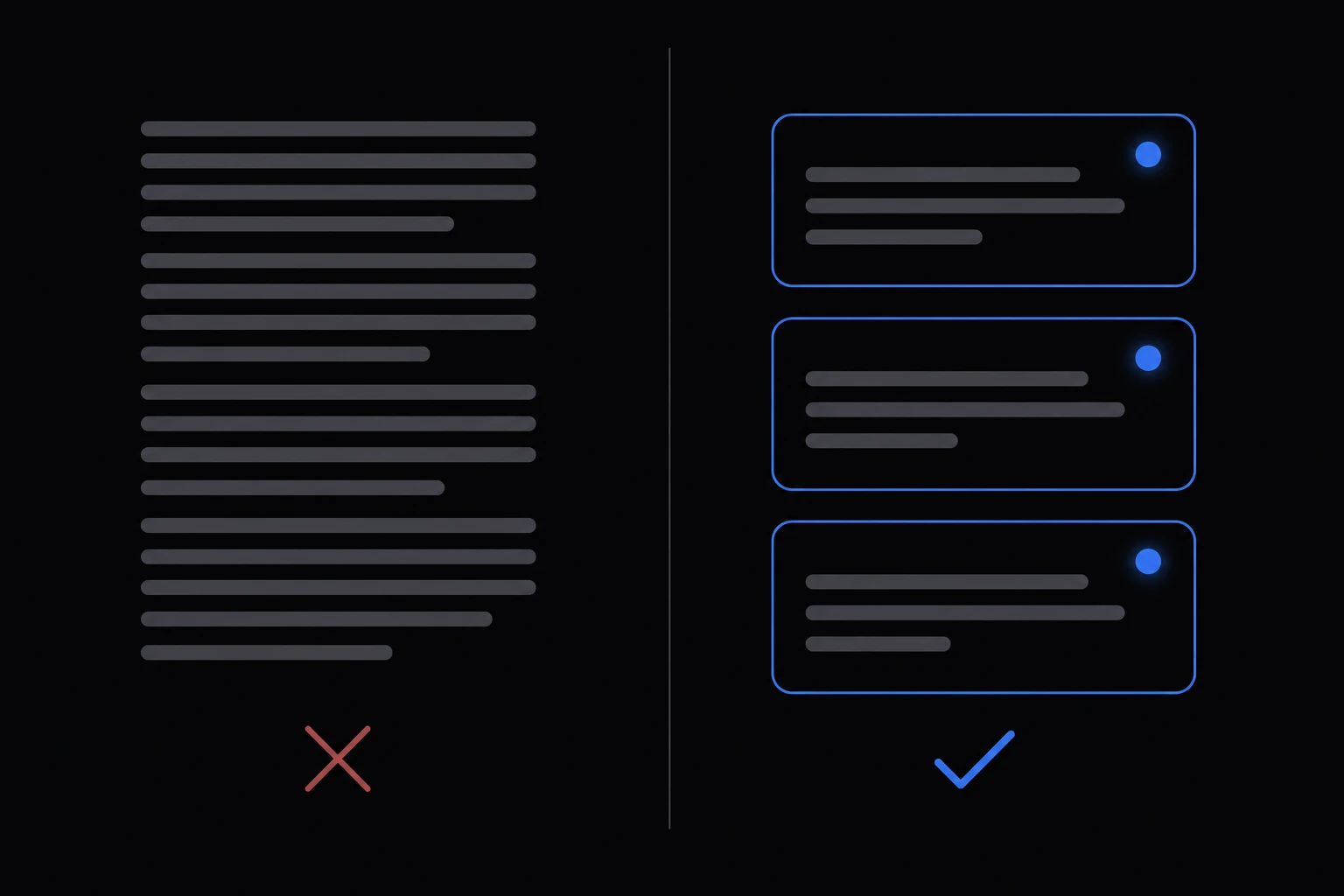
Structural elements survive extraction far better than prose. A comparison table with clean rows is a single lift: the engine takes the whole table and attributes it. The same comparison written as three paragraphs of flowing text gets summarized — and the summary may merge your claims with a competitor's without clear attribution.
Use tables for: feature comparisons, pricing tiers, platform differences, metric definitions. Use numbered lists for: processes, steps, sequences. Use bullet lists for: independent items, options, requirements. Each one is a citable unit that an engine can extract intact.
6. Define your terms in place
AI engines reconcile entities across the web. If your page introduces a term, define it immediately and consistently — the same words, every time. "Citation rate is the percentage of monitored AI answers that link your domain as a source" is a citable definition. "Citation rate, which we discussed earlier, is basically how often you get linked" is not — it depends on context, uses vague language, and will be paraphrased.
This matters doubly because engines use your definitions to understand what an entity is. If you describe your own product inconsistently across pages, the engine hedges — and may cite someone else's description of you instead of yours. Entity consistency is not just branding; it is a citation signal.
7. Write for the rewritten query, not the prompt
When a user asks an AI assistant a vague question — "what's the best CRM?" — the engine rewrites it into sharper sub-queries: "best CRM for small agencies," "CRM pricing comparison 2026," "HubSpot vs Salesforce for teams under 50." Your content gets retrieved for the sharp versions, not the vague one.
This means your page should target the specific, sharp questions that an engine would generate — not the broad topic. A page titled "CRM Guide" competes for everything and wins nothing. A page that answers "How much does PilotCite cost per month for 5 seats?" wins a citation for exactly that question, every time it is asked.
- Answer first, elaborate second — the atom before the narrative.
- One idea per section — make extraction unambiguous.
- Specifics beat adjectives — numbers, names, dates over descriptors.
- Fact density — a concrete, quotable claim every 150–200 words.
- Tables and lists survive extraction; prose gets paraphrased.
- Define terms in place — consistent, self-contained definitions.
- Target the rewritten sub-query, not the vague prompt.
What kills citations (the common mistakes)
Most content that fails to earn AI citations is not bad content — it is good content structured for the wrong reader. Here are the failure modes we see most often:
The buried answer. The page contains a perfect answer to the question, but it is in paragraph six, after three paragraphs of context the engine does not need. The engine finds a competitor who put the answer first and cites them instead.
The context-dependent passage. "It starts at $49, as mentioned above." The "as mentioned above" makes this passage unusable in isolation — an engine cannot lift it without the preceding context, so it paraphrases and drops the attribution.
The adjective wall. A section full of "powerful, intuitive, comprehensive, seamless" with no specifics anywhere. There is nothing to quote, so the engine summarizes the gist and credits no one.
The unstructured comparison. Two products compared across five paragraphs of flowing analysis, with no table, no side-by-side, no clean extractable unit. The engine blends the comparison and attributes the synthesis to itself.
The orphaned definition. A term used throughout the page but never cleanly defined in one self-contained sentence. The engine finds someone else's definition and cites that instead.
How to test if your content is citable
You do not have to guess. The same prompt monitoring approach that tracks your citation rate over time lets you test specific pages:
- Identify the question your page targets — the sharp, rewritten sub-query version, not the broad topic.
- Ask it on ChatGPT, Perplexity, and Google AI Overviews — and see whether your page is cited, paraphrased without credit, or absent.
- If absent or paraphrased, check retrievability first — is the page server-rendered, crawlable, not blocked? An AI readability audit confirms the page is even in the candidate set.
- If retrievable but uncited, restructure — apply the seven rules to the section that should answer the question, then re-test on the next monitoring run.
The loop is the same one from GEO vs SEO: measure, fix, re-measure. The difference is that here the fix is editorial — changing what the passage says and how it is structured — not technical.
Frequently asked questions
Not all at once. Start with the pages that target questions your buyers actually ask AI assistants — pricing, comparisons, definitions, how-to. Apply the seven rules to those, re-test citation rate on the next monitoring run, and expand from there. The highest-intent pages are where the payoff is largest.
No — it reinforces it. Answer-first structure, clear headings, fact density, and tables are signals that both Google and AI engines reward. The citable-atom structure is a superset of good SEO practice, not a departure from it.
Typically 2-4 sentences — enough to make a specific, self-contained claim, short enough to be extracted intact. A passage that runs for multiple paragraphs gives the engine more to paraphrase and less to quote cleanly. One question, one answer, one atom.
Schema helps engines classify your pages, but the liftable passage is what wins the citation — not the tag. Treat structured data as hygiene (use it, keep it correct), but put your effort into the passage itself. A perfectly tagged page with a buried answer still loses to an untagged page that answers first.