

What is AEO? Answer engine optimization explained
Answer engine optimization (AEO) is the practice of structuring content so that answer engines — Google AI Overviews, featured snippets, Perplexity, ChatGPT with browsing, voice assistants — select your passage as the answer they present or quote. Classic SEO competes for a position in a list of results; AEO competes for the answer itself. The work overlaps heavily with generative engine optimization: make pages machine-readable, lead every page with a self-contained answer, and measure citation rate on the questions your buyers actually ask. For how this splits a budget against classic SEO, see GEO vs SEO.
AEO is one of three labels — alongside GEO and LLM SEO — that people attach to roughly the same shift: search systems that answer instead of listing. The labels get used interchangeably, which makes the category confusing from the outside. This article pins down what the AEO angle specifically means, shows how an answer engine picks the one passage it quotes, and ends with a five-minute test that tells you who currently owns the answers in your category.
What does answer engine optimization actually mean?
Start with the noun, because it does most of the work. An answer engine is any system that responds to a question with one composed answer rather than a menu of options. A classic search results page hands you ten links and lets you judge; an answer engine judges for you, presents its conclusion, and — at best — credits a small number of sources. AEO is the discipline of becoming one of those sources: the page whose passage gets lifted, quoted, or read aloud.
The term is older than the current AI wave, and that lineage explains its emphasis. When Google introduced featured snippets, a single extracted passage started answering the query above every ranked result, and voice assistants sharpened the same dynamic to its extreme: a smart speaker reads out exactly one answer, so the contest is winner-take-all. Practitioners who optimized for those surfaces were already doing AEO years before ChatGPT existed. Generative engines did not invent the answer slot — they multiplied it, stretched it from one lifted sentence into a synthesized paragraph, and attached a short list of citations to it.
That history compresses into three eras, each shrinking the space you compete for:
| Era | Surface | What you compete for |
|---|---|---|
| Results page | Ten blue links | A position in the list |
| Answer box | Featured snippets, voice assistants | The single extracted passage |
| Generative answer | AI Overviews, ChatGPT, Perplexity | A citation slot inside a synthesized answer |
The through-line is scarcity. A results page has ten winners per query; an answer has a handful of cited sources, sometimes one, sometimes none. That scarcity is why AEO techniques concentrate so hard on the passage level — when only one block of text gets lifted, the shape of that block decides everything.
Where does AEO end and GEO begin?
In practice, nowhere clean — a team doing one is doing the other, and the levers below serve both. The distinction is emphasis, and it matters mainly when you are reading advice or comparing tools.
AEO advice leans toward content structure: answer-first openings, question-form headings, compact extractable blocks, schema markup. GEO adds the brand layer on top — entity consistency, third-party corroboration, share of voice against competitors across engines. If a page fails to get quoted, AEO thinking asks "is the passage liftable?", while GEO thinking also asks "does the engine trust this brand enough to cite it at all?". Both questions are usually worth asking, which is why the terms keep collapsing into each other. The glossary entry on AEO keeps the short version of this distinction if you need one to hand a colleague.
Pick whichever label your team already uses. The engines don't read your internal docs, and the work is identical from here down.
How does an answer engine choose the passage it quotes?
Every answer engine, from a featured snippet to a browsing chatbot, runs some version of the same four moves. Understanding them tells you exactly where your content is being judged.
First, it interprets the question. The engine classifies intent and — critically — the expected shape of the answer: a definition wants one tight paragraph, a "how do I" wants steps, a "which is better" wants a comparison. Your passage competes not just on relevance but on shape. A 2,000-word essay can lose a definitional query to a competitor's two crisp sentences, because two sentences are what the answer calls for.
Second, it retrieves candidates. Depending on the engine this means querying a search index, browsing live, or both, usually after expanding the question into several sub-queries. The mechanics of that expansion and pooling are covered in how LLMs decide what to cite; what matters here is the entry fee — if crawlers can't fetch and render your page, you are not in the pool, and no amount of structure fixes that.
Third, it extracts and scores passages. This is the step AEO lives in. The engine does not weigh your page as a whole; it slices candidates into blocks and scores each block on its own: does it answer the question directly, is it self-contained, does it carry a concrete fact, does it match the expected shape? A block that starts "as we mentioned above" dies here — cut off from the rest of the page, it no longer means anything.
Fourth, it selects and attributes. From the surviving blocks, the engine assembles its answer, preferring claims that multiple independent sources agree on, and attaches citations to the passages it actually leaned on. Slots are scarce at this stage, and corroborated facts beat orphaned ones.
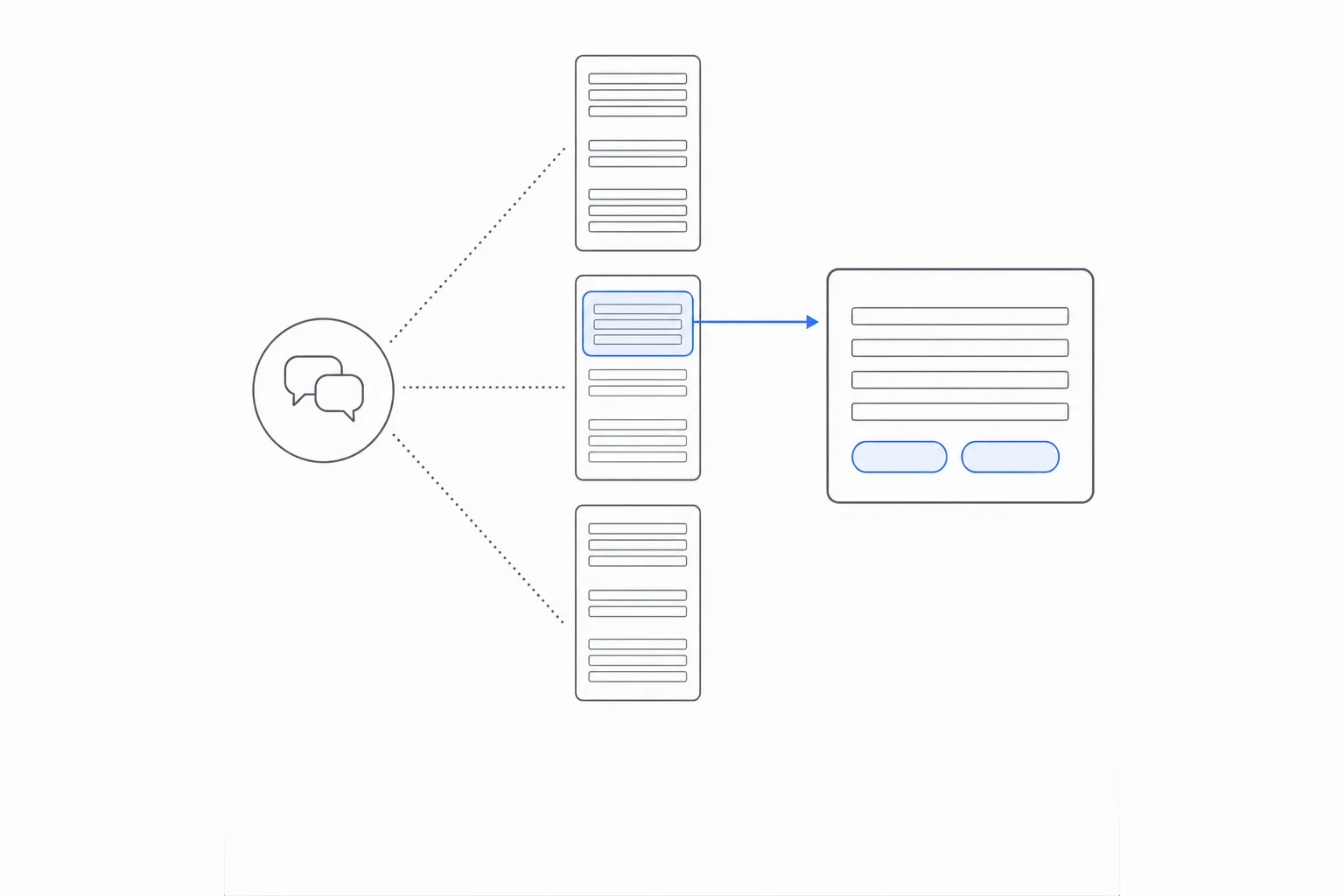
Notice what is absent from the four moves: nothing rewards total word count, publishing frequency, or how many subtopics one URL covers. The unit of competition has moved below the page, and most content produced for classic SEO simply has no block that survives step three.
What makes a passage liftable?
A liftable passage — an answer unit — has an anatomy you can check line by line. The strongest ones share five properties:
- A heading that matches the question. Not cleverness, the question — phrased the way a person asks it. The heading is the engine's first relevance signal for the block beneath it.
- A first sentence that answers. No wind-up, no "in today's fast-moving landscape." The opening sentence should survive being quoted alone.
- Self-containment. Every pronoun resolves inside the block; no "as discussed above," no references that require scrolling. The block will be judged — and possibly displayed — in total isolation.
- One concrete fact. A number, a limit, a named mechanism. Concrete claims are what engines corroborate across sources; adjectives are not checkable and earn nothing.
- The expected shape. Definition questions get a tight paragraph, process questions get numbered steps, comparison questions get rows. Match the shape or lose to whoever did.
Here is the difference in practice. A page about response-time guarantees that opens with "Customer expectations have never been higher…" and reveals the actual guarantee in paragraph six has no liftable unit. The same content restructured — a heading asking "How fast is support response?", a first sentence stating "Support responds within two hours on business days, on every plan," then the qualifications — hands the engine a block it can quote verbatim. Nothing about the underlying facts changed; the packaging decided the outcome. The full set of writing rules, including the mistakes that quietly kill extraction, is in how to write content AI engines actually cite.
One honest note on schema markup, since AEO advice tends to oversell it: structured data helps engines parse what a block is — an FAQ, a how-to, a product fact — and it is cheap to add. It does not override content. Marked-up fluff is still fluff, and an unmarked page with a clean answer unit beats it.
What's a five-minute test you can run today?
Theory aside, you can watch answer selection happen right now, on the query this article targets.
Ask two or three engines — Google (watch for the AI Overview), Perplexity, ChatGPT with browsing — the question "what is answer engine optimization." Look at which sources each engine cites, then open one cited page and find the exact passage that got quoted. It will almost always be a compact, self-contained block near the top of the page: a definition of two or three sentences that survives out of context. You have just watched step three of the pipeline from the outside.
Now run the test that matters: replace the query with the question that starts your own buyers' research — "what is [your category]" or "best [your category] for [your segment]." Note who gets cited and whether you are among them. Then open your own page that should win that query and find your first sentence that directly answers it. If you have to scroll to find it, so does the engine — and unlike you, it has nine other candidates open in the next tab.
How do you measure AEO?
Rankings won't tell you, because AEO outcomes live in the answer layer, not the results list. You can rank third for a query and be absent from its AI Overview, or rank nowhere and be Perplexity's first citation. Measurement has to happen where the answers are.
The method is a fixed question set, run on a schedule, with evidence kept. Pick the buyer questions that matter — sourcing them properly is its own discipline — run them across the engines your buyers use, and score the answers: were you mentioned, were you cited, who took the slots you didn't? Over time those runs become citation rate and share-of-voice trends, and the interpretation rules in AI visibility metrics turn the trends into next month's publishing list.
At small scale a spreadsheet works. When the question set, engine list, or number of stakeholders grows, the bookkeeping breaks before the method does — that is the point where a tool like PilotCite earns its keep, running the same question set across eight engines on a schedule and keeping the evidence. The free plan baselines five prompts on ChatGPT, which is enough to run the five-minute test above properly, every week, without you remembering to.
- An answer engine returns one composed answer with a handful of cited sources — being ranked on the classic results page does not guarantee being one of them.
- AEO predates generative AI: featured snippets and voice assistants already made single passages, not pages, the unit of competition.
- Answer engines score blocks in isolation — a passage that depends on surrounding context ("as mentioned above") cannot be lifted.
- The expected answer shape matters: definitions want a tight paragraph, processes want steps, comparisons want rows.
- Schema markup helps engines parse a block but does not override content quality; a clean unmarked answer unit beats marked-up fluff.
Frequently asked questions
They describe the same shift with different emphasis. AEO focuses on content structure — answer-first passages, question-form headings, extractable blocks. GEO adds brand-level work: entity consistency, third-party corroboration, and share of voice across engines. A team doing one is in practice doing the other.
Yes — the passage-level discipline AEO names is exactly the part most content still gets wrong. Whatever label you use, engines lift self-contained blocks, and building those blocks is AEO work. The label may fade; the mechanics are becoming more important, not less.
No. Structured data helps engines parse what a block is, and it is cheap insurance, but selection is decided by the content itself: directness, self-containment, concrete facts, and corroboration by other sources. Markup on a weak passage changes nothing.
Engines that retrieve live can pick up an improved passage as soon as they re-crawl the page — days to a few weeks. Answers drawn from model memory only shift after a training update. A monthly re-measurement rhythm over a fixed question set is the realistic pace for judging progress.
No — the same URL serves both. Restructuring a page to lead with a self-contained answer does not hurt its classic rankings; crawlability, authority, and intent match still carry over. AEO is mostly a repackaging of pages you already have, not a parallel content program.