

LLM SEO: make large language models retrieve, cite, and recommend your brand
LLM SEO is the discipline of earning brand mentions and linked citations inside AI-generated answers. It is the same core idea as generative engine optimization: influence what large language models retrieve, trust, and surface. The program is mechanical — ensure machine access, remove entity ambiguity, publish citable answer units, build corroboration, and measure share-of-voice shifts across engines. For where this sits next to your classic SEO budget, see GEO vs SEO; for the numbers to track, see AI visibility metrics.
The term is everywhere and the definitions are sloppy, which makes the work look mystical. It is not. An LLM answer is the output of a pipeline — memory, retrieval, reranking, synthesis — and every stage of that pipeline is something you can influence with ordinary publishing decisions. This guide defines the term precisely, walks through the pipeline, and lays out a four-week program you can run without waiting for anyone's permission.
What LLM SEO is
LLM SEO — search optimization for large language models — is the practice of shaping what models like ChatGPT, Gemini, and Claude can access, understand, and are willing to cite about your brand. The goal is not a blue link on a results page, but a slot inside a synthesized answer: "According to [your brand]…" or a linked citation to your page, doc, or profile that the model uses as evidence.
You will also see "GEO" (generative engine optimization) and "AEO" (answer engine optimization). These are the same practice with slightly different emphases. LLM SEO foregrounds the model as the decision-maker. GEO focuses on the broader class of generative engines — models plus retrieval, UI, and policies. AEO is older search jargon for optimizing to be the answer rather than one of many results.
| Term | Emphasis | Where you'll hear it |
|---|---|---|
| LLM SEO | Model behavior and citation mechanics: training vs retrieval, prompt shaping, citations | AI product teams, technical marketers, model-centric discussions |
| GEO | End-to-end generative engines (model + fetcher + UI + policies), cross-engine coverage | Search strategists, platform comparisons, vendor roadmaps |
| AEO | Being the answer unit: definitions, featured snippets, structured facts | Traditional SEO circles, SERP-feature optimization |
Whichever label you use, the levers below are identical. Pick one term for internal documents and move on — the engines do not care what you call the work.
How an LLM decides what to cite
At a high level, an LLM answer draws from two layers: what the model "remembers" in its parameters and what it can retrieve live at generation time. Engines vary in how strongly they lean on each layer, and the balance changes with query type.
Parametric memory vs live retrieval. The model's parametric memory encodes patterns learned during pretraining and any fine-tunes. It is good at stable facts the model has seen repeatedly across sources, and it does not update without a new training run. Live retrieval augments the model with documents fetched at answer time from the open web, vertical sources, or proprietary indexes. Retrieval supplies freshness and citations; a system answering without browsing may still state facts from memory, but it will show fewer or no citations.
Query fan-out. Before retrieval, the engine expands your prompt into multiple search-like sub-queries. It tests alternative phrasings, synonyms, and constraints — "best for SMB," "pricing," "examples," "vs competitor" — and may branch by geography or inferred intent. This fan-out broadens coverage and hedges against any single poor query. You can see it in the output: ask an engine "what is the best AI visibility tool" and the citations often trace to pages targeting "AI visibility tools comparison," "[vendor] alternatives," and "[vendor] pricing" — sub-queries you never typed.
Candidate pool assembly. Each sub-query returns a short list of documents. The engine merges them into a candidate pool, deduplicates near-duplicates, normalizes URLs, and clusters by host and entity. It attaches features to each candidate: text relevance against the working answer, recency, source type, topical authority signals, and whether the passage looks self-contained enough to quote.
Citation selection and synthesis. The model drafts an answer using both memory and retrieved snippets. A reranker then selects a small set of sources to cite, balancing relevance with diversity across domains, corroboration between sources, and UI constraints — citation slots are scarce. The final answer inserts citations at the segments where evidence was pulled.
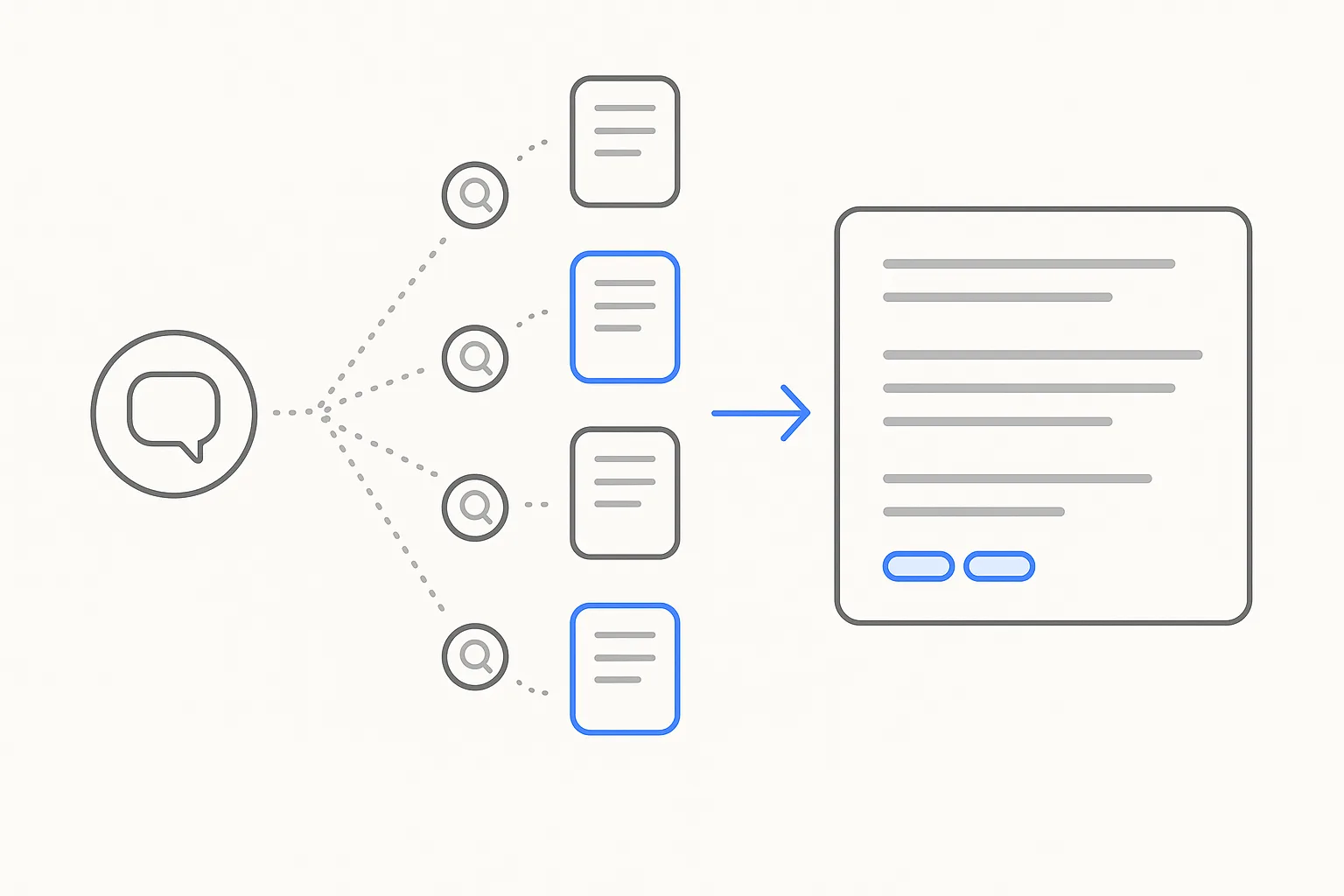
The implication for practitioners: you influence both what enters the pool and how your pages compete inside it. That means getting crawled, looking like the right entity, offering liftable answer units, and being corroborated on pages the engine also retrieves.
The six factors that decide LLM visibility
Everything below is unglamorous, and that is the point: none of it needs a growth hack, just competent publishing applied where engines actually look. Work the factors in order — each one compounds the next, and a weakness in an early one caps everything after it.
1. Machine access — crawlers, robots, and JavaScript
Access. If fetchers cannot load your content, you do not exist to the engine. Confirm robots.txt and meta robots allow the relevant user-agents — general search bots and the AI-specific crawlers — to fetch your key pages, and watch for over-broad folder-level disallows that quietly hide docs or pricing.
Server behavior. Test your pages with a headless fetch: a 200 status, correct content type, and complete HTML without client-side rendering. If primary content depends on JavaScript, provide server-side rendering or prerendered snapshots. An AI-readability audit exists precisely because pages that look fine in a browser often read as empty to a crawler.
Sitemaps and feeds. Ship XML sitemaps with accurate lastmod values, and expose RSS/Atom feeds for docs and changelogs to hint at freshness.
Stability. Limit interstitials, consent walls, and rate limits that block automated clients. Slow assets make headless renderers time out and conclude the page is empty.
2. Entity clarity
Disambiguation. Models cluster citations by entity, not by URL. If your brand shares a name with anything else, make the canonical form unambiguous: consistent brand string, descriptor, and tagline across your site and profiles, plus a one-sentence disambiguation on the pages where confusion is likely.
Structured signals. Use Organization and Product markup to assert names, alternate names, and sameAs relationships, and keep handles and domains consistent. The concrete patterns are in how AI engines decide you're "you".
Landing-page alignment. Give each entity one stable URL that answers what it is, who it is for, and how it is used — in skimmable blocks — and link related entities together so clustering works in your favor.
3. Citable structure
Liftable units. Engines favor passages that can be lifted without the rest of the page: a one-sentence definition, a numbered list of steps, a compact comparison row, an explicit price or limit. Place them near the top and label them clearly.
Answer-first writing. Write so a model can extract the answer without scrolling: question-form subheads, short paragraphs, a summary block with definitive statements and specific numbers. The full set of writing rules is in how to write content AI engines actually cite.
Friction. Keep content readable without cookie walls, email gates, or scripts that block text extraction — and make the canonical version the cleanest one.
4. Corroboration and third-party presence
Redundancy across hosts. Engines down-weight claims that exist only on your own site. Your definition, category fit, and key facts should also appear on third-party pages the engines already crawl: integration directories, comparison pages, marketplaces, community threads. The goal is agreement on the basics, not duplicated marketing copy.
Evidence depth. Provide primary sources a model can point to — technical docs, support articles, pricing pages with explicit numbers. When your own pages and third-party pages agree, your odds of selection rise.
Narrative shapes. Many prompts arrive as "best X for Y," "alternatives to Z," or "X vs Y." Make sure those comparison frames exist somewhere retrievable, stated cleanly and without over-claiming.
5. Freshness and retrievability
Update paths. Live-retrieval engines revisit sitemaps and feeds. Use lastmod and pubDate accurately, and keep a visible "last updated" line so extracted snippets carry freshness cues.
HTTP hygiene. Stable canonical URLs, 301s when you must move, no soft 404s. Out-of-sync duplicates of a changed fact — old pricing on one page, new pricing on another — push the reranker toward a competitor host with cleaner agreement.
Retrieval ergonomics. Avoid infinite scroll on index pages you want crawled; provide paginated archives with clear next and previous links.
6. Per-platform behavior differences
ChatGPT. With browsing on, it fans out across web sources and shows a limited set of inline citations, favoring concise definitional passages and docs for technical queries. Tactics specific to it are in how to get cited by ChatGPT.
Google AI Overviews and AI Mode. These blend corpus knowledge with live retrieval grounded in the Google index, so classic crawl and quality constraints carry over — but the citation unit is an answer paragraph, not a ranked listing. See AI Overviews for how grounding works.
Gemini, Perplexity, Claude, Copilot, Grok. Each has distinct retrievers, UI constraints, and citation policies: some prioritize domain diversity, some weigh recency more heavily, some show references at the end rather than inline. Expect different results for the same prompt, and treat each engine as its own channel sharing the same four inputs — access, entity clarity, citable structure, corroboration.
The LLM SEO program
You can run LLM SEO as a tight four-week loop, then repeat. The cadence keeps you close to measurable movement on the prompts that matter to your buyers.
If you only have one hour this week, do the smallest version of Week 1: pick ten buyer prompts, run them on two engines, and save the answers somewhere you can find again. That single baseline — who gets named, who gets cited, where you are absent — usually reframes the entire content roadmap, and everything below just scales it up.
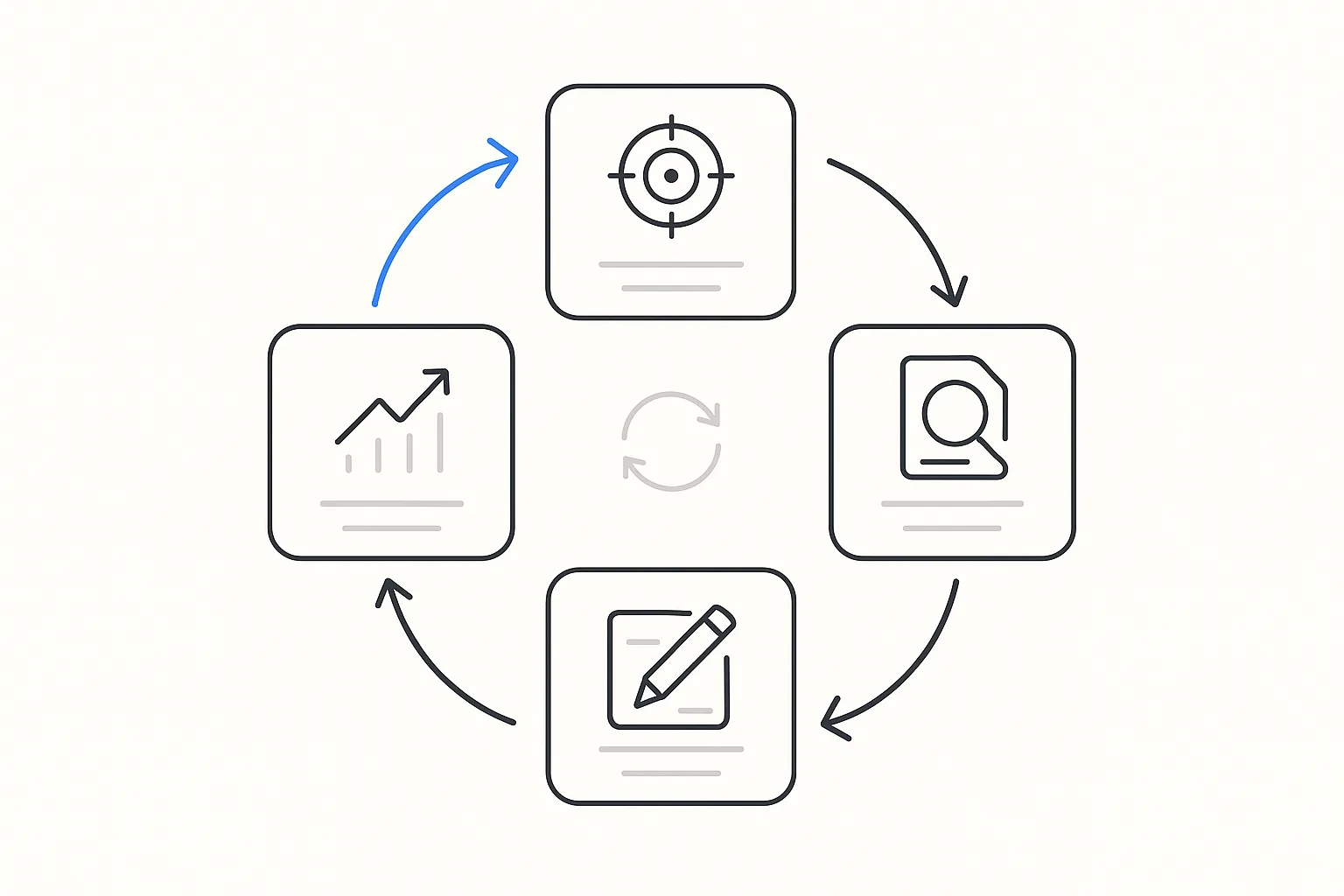
Week 1 — baseline and prompt set
Define the prompt set. Start with 10–25 prompts that represent your commercial surface: "what is [category]," "best [category] for [segment]," "[competitor] alternatives," "[brand] vs [competitor]." The sourcing method is covered in how to find the buyer prompts your customers ask AI.
Run the baseline. For each engine you care about, record the answer, which sources it cited, and whether your brand was mentioned, linked, or recommended. Keep the evidence — an answer you cannot re-open is a number you cannot defend.
Quantify. Compute citation rate and share of voice across the prompt set, by engine and by intent bucket. This baseline is the denominator for everything that follows.
Week 2 — access and entity audit
Crawlability. Validate robots.txt, canonicals, sitemap coverage, and server responses for the pages that should win citations, and fetch them headlessly to confirm the content renders without JavaScript — a site audit automates the checklist.
Entity coherence. Standardize names and descriptors, update Organization and Product markup, add the disambiguation line where needed, and crosslink entity pages.
Retrieval surfaces. Make sure docs, pricing, and comparison pages exist as first-class URLs with clear titles, and expose feeds for anything that changes often.
Week 3 — publish against gaps
Close definitional gaps. Create or refactor the "what is [X]" block for your category and product; add liftable comparison rows and explicit numbers.
Build corroboration. Update the third-party listings that reflect your canonical description, and hand partners a one-paragraph boilerplate with correct links.
Split overloaded pages. Where one URL tries to answer too many intents, split it so each page maps cleanly to a prompt cluster, and align titles and H1s with the prompt language you are targeting.
Week 4 — re-measure and refine
Re-run the prompt set. Compare citation-rate and share-of-voice deltas by engine and prompt cluster; inspect where you were added, where you were dropped, and which sources beat you.
Diagnose misses. For prompts where you are absent, check in order: did fetchers reach the page, does it contain a liftable unit, and is the claim corroborated anywhere else? The failure is almost always one of those three.
Lock the loop. Turn the diagnosis into next sprint's publishing list, keep a monthly re-measurement rhythm, and reserve a weekly slot for quick wins — tightening a definition block, updating a stale number.
Do you need an LLM SEO tool?
You can run a basic program manually if the scope stays small: a dozen or two prompts across one or two engines, checked on a schedule, evidence saved to a spreadsheet. That honesty cuts both ways — manual runs break down as engines, prompts, geographies, and stakeholders multiply, not because the method changes but because the bookkeeping does.
Tooling adds repeatability at scale: scheduled runs across the major engines, evidence capture, per-engine share-of-voice and citation-rate rollups, and gap detection by prompt cluster. PilotCite does this as one workflow across ChatGPT, Gemini, Perplexity, AI Overviews, AI Mode, Claude, Copilot, and Grok — see pricing for where the free tier ends and paid plans begin.
- An LLM answer draws on two layers: parametric memory (updates only at training time) and live retrieval (updates as fast as your pages are re-crawled).
- Citation slots are scarce — a single clean definition or comparison row can outperform a long guide with no liftable units.
- JavaScript-dependent rendering hides primary content from many headless fetchers; server-rendered HTML increases inclusion in candidate pools.
- Prompt phrasing changes the retrieval fan-out, so a stable, scheduled prompt set is more reliable than ad hoc spot checks.
- Engines corroborate before they cite: facts that exist only on your own domain are weaker candidates than facts echoed by third-party pages.
Frequently asked questions
They name the same discipline: earning visibility inside AI-generated answers. LLM SEO emphasizes model behavior and citation mechanics, while GEO emphasizes the broader generative engine stack. In practice the levers and workflows are identical, and both overlap heavily with answer engine optimization.
Yes. Crawlability, fast servers, clean information architecture, and a credible link profile all feed the retrieval layer that LLMs draw from. What changes is the unit of competition: you win with liftable answer units and third-party corroboration rather than long-form coverage alone.
For engines that browse, improvements to access, structure, and content can show up within days to a few weeks of being re-crawled. Answers leaning on model memory wait for a training cycle. A monthly measurement rhythm is the realistic pace for seeing stable shifts across a prompt set.
Yes, at small scale: a fixed prompt set, one or two engines, a weekly schedule, and disciplined evidence capture in a spreadsheet. Tooling becomes worth it when prompts, engines, or stakeholders multiply and manual bookkeeping starts skipping runs or losing evidence.
Start where your buyers actually research: for most teams that means ChatGPT and Google AI Overviews first, then Perplexity or whichever engine your niche favors. Validate with a small pilot prompt set before spreading effort across all eight platforms.
Often more than for big ones. Retrieval rewards clean, specific, self-contained answers over raw domain authority, and an answer names only a handful of sources — so a small brand with a precisely structured page can take a citation slot that a larger competitor holds on the classic results page. The scarce slots cut both ways: harder to enter, more valuable to hold.